

The Optimal Garage Temperature During Cold Months Isn't As Simple As You Thought
As temperatures plummet and fall turns into winter, most homeowners face a familiar internal debate: Do I heat the garage, or let it freeze? While some garages have built-in insulation, others are drafty iceboxes. If your garage contains more than just cars, like a spare fridge, your prized power tools, and storage boxes, you've probably wondered if you should keep it warm. Fortunately, learning how to warm up your garage during freezing cold winters doesn't have to mean racking up an astronomical electric bill. The key to keeping your garage safe during the cold winter months is keeping the temperature above the average dew point — around 40 degrees Fahrenheit in dry climates and 65 degrees Fahrenheit in coastal areas.
You may have been told to keep your garage at a temperature just above freezing to avoid damaging your plumbing pipes, or to turn up the heat to ensure your car's engine is nice and toasty when you need to go somewhere in the morning. But what most people don't know is that the ideal winter temperature for a garage is really a trade-off between keeping things at a reasonable temperature and maintaining the right level of humidity. Simply put, if you're looking for an exact temperature to set your garage's thermostat to, you're looking for the wrong thing.
The real enemy of a winter garage isn't the cold — it's condensation. Condensation in your garage happens whenever warm, humid air hits a chilled material like metal, glass, or concrete. When warm, humid air comes into contact with cold walls, doors, floors, windows, or worktables, moisture can quickly accumulate on those surfaces. This moisture can lead to tools developing flash rust and cardboard storage boxes soften and grow mold. Overall, it creates a surprisingly destructive environment for your home and belongings.
How to protect your garage from cold and condensation
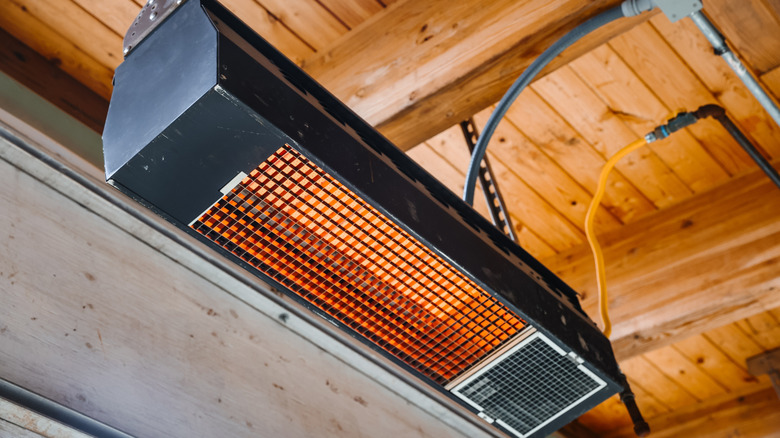
Dew points vary depending on the air's temperature and moisture content, so your baseline temperature should be determined by your area's normal winter humidity. For inland areas, where the winter air is typically drier, a good baseline is 40 degrees Fahrenheit or higher. This is warm enough to keep the ambient temperature above the dew point of the outside air and prevent stored liquids from freezing, but cool enough to avoid overheating the garage. If you live along the coast or near large bodies of water, where winter air tends to be more humid, set your garage heating closer to 65 degrees Fahrenheit to lower relative humidity and help prevent surface condensation. If you need a reliable heating setup, you can warm up your garage during cold months with an easy-to-install solution: a portable or wall-mounted heater.
Of course, maintaining these temperatures can quickly rack up an expensive heating bill if your garage isn't properly insulated. To help protect your garage without breaking the bank, make sure you take steps to prepare your garage door for winter. For example, insulating the garage door will help keep its surface temperature closer to the air temperature inside the garage, reducing the chance of condensation. Another way to prevent condensation is to run a dehumidifier. If you live in a high-humidity area or cannot keep your garage up to the recommended temperature, choose a low-temperature rated dehumidifier. The dehumidifier will pull the moisture from the air before it has a chance to condense on the cold surfaces in your garage. If you park a car with snow on it in your garage, knock off the snow and squeegee up any puddles of water so they do not evaporate into the air as water vapor.