

Do Professional Painters Always Do Two Coats Of Paint?

Trying to repaint your house on a budget or in a hurry? If so, you might wonder if it's really necessary to use two coats of paint or if using just one coat could be a time-saving and efficient painting hack. To best answer that question, it's wise to defer to the experts. In a YouTube video, Nick Mays, professional painter and owner of Walls by Design explained, "Most manufacturers are going to recommend thin coats of paint in multiple layers. They don't want you to go with just one coat really ever. You always want to have two coats to make sure that you have even coverage."
Across multiple companies in the industry, two layers is treated as the standard. There are several reasons for this, but one of the most important is that a double coat provides more uniform coverage than a single one. When the first layer dries, it might look streaky or inconsistent, but a second one can help even it out. On top of that, multiple coats deliver better long-term performance, creating a stronger barrier that holds up better against scratches and scuffs, while also protecting your walls from damage. From an aesthetic perspective, a second layer of paint also adds depth, so the colors look richer and carry the right undertone. This can be especially important for some colors.
That said, there are some specific situations where one coat might work. For example, if you plan to repaint your walls in the same color, you could get away with a single coat. The quality of your paint matters too. A less expensive paint will typically require more layers to achieve proper coverage, while premium paints are more densely packed with color pigments. Even then, you might find that one layer isn't enough.
Most situations will call for at least two coats
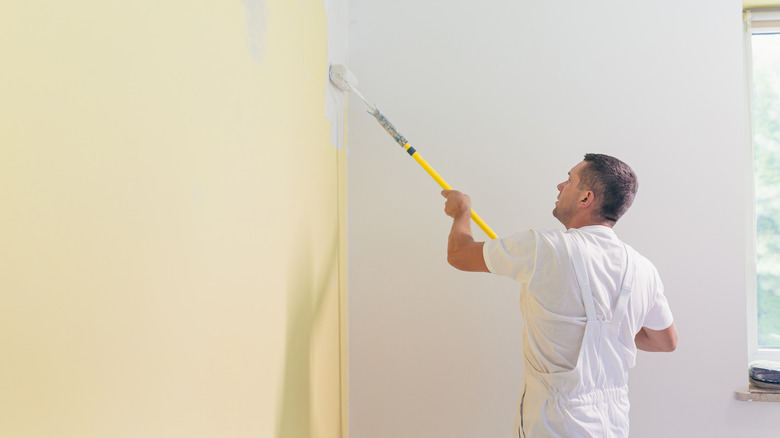
If you want to achieve professional-looking results on your own, applying two coats of paint is a pretty standard move. There are also specific situations when two layers are absolutely necessary. In some cases, you might even need three. For example, if you're making a dramatic color change, like going from a dark gray to white or vice versa. The stark color difference is likely to peek through with just one layer of paint. You'll also need multiple coats of paint when you're working with bare or porous surfaces, like newly installed drywall, which soaks up wet paint unevenly. A coat of primer is quintessential to seal the surface, then you can follow up with two or more coats of paint.
However, after learning all of this, you might be tempted to slather on as many paint layers as possible — but be careful not to over do it. If you coat a wall too many times, you could end up with uneven, messy-looking walls or problems with cracking and peeling. Something else to keep in mind: if you're bringing in a pro, there are some important question to ask before hiring a painter. Find out how many coats they plan to apply. As you know by now, the industry standard is two, so it could be a red flag if they say that one is enough. In that case, it might be best to get a second opinion to avoid potentially being scammed by a painter.