

Can You Use An Angle Grinder To Cut Through Concrete?
We may receive a commission on purchases made from links.
Angle grinders are essential tools that every DIYer needs to own. They pack a powerful punch in a small package, and whether you need to remove rust, sharpen a blade, or cut pipes, they're the best tool for a variety of jobs. The most common application, however, has to do with metalwork, which may leave you wondering whether it will come in handy for cutting other materials, like concrete. The answer is yes, but it's important to use the proper blade in order to ensure that the completed job is safe and precise.
If your angle grinder is powerful and equipped with a concrete-rated diamond blade, like this Makita 7 in. Segmented Diamond Rim Blade, it should cut through shallow sections of the material without much issue. These blades are specifically intended for hard, rock-like materials like stone, pavers, and bricks, so they're sometimes called masonry blades. That said, it's still important to understand the limitations. Angle grinders, like any handheld tool, can perform very well, even against tough materials, but power can vary widely based on the model. If your angle grinder struggles with simpler projects, it will probably disappoint here. Instead of pushing it to its limits, it might be time to check Home Depot or Lowe's for deals on saws specifically designed for concrete.
Preparing to cut concrete with your angle grinder

Before you start, there are two things you need to consider: proper blade style and protection while you're cutting. A diamond blade is necessary for cutting concrete, but within this category, there are several designs to choose from. Segmented blades with notches around the edges help to kick away dust and are best for quick cuts, though they might not yield the smoothest results. Continuous rim blades cut a bit slower, but they're great for an ultra-precise finish. Turbo rim blades offer a compromise between the two, have some serration, and are a good all-purpose option for projects where you want both speed and neatness. Your angle grinder's size will determine the largest blade it can take, so make sure you purchase a blade with this limit in mind.
Lastly, proper dust mitigation and personal protective equipment (PPE) are extremely important, and forgoing them is one of the biggest mistakes you can make as a new DIYer. Concrete gets very dusty when it's cut, and breathing it in can be incredibly harmful. Consider wetting the material to reduce dust kickback, closing off the area if you're working indoors, and setting up a dust shroud on a shop vac to keep things under control. Regardless of your mitigation strategy, you should wear protective eyewear, a dust mask, and hearing protection while you're cutting.
Understanding concrete cutting techniques
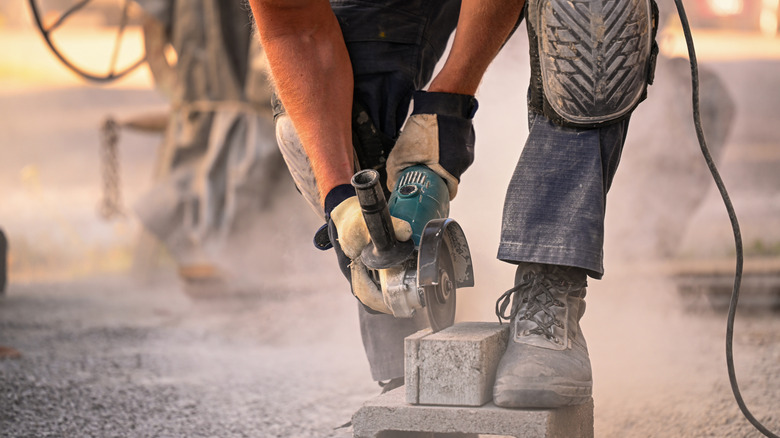
If you're using an angle grinder to cut concrete for the first time, it might present a bit of a learning curve. After you've installed your blade and put on your PPE, power on the angle grinder and give it a second to get up to full speed before bringing it to the concrete. Move it down slowly rather than plunging it into the material — you want to let the blade do its job — and achieve more depth gradually.
If you're cutting fully through the material, go halfway down on the first pass, then complete the cut on the second. You can even flip it over to finish the cut from the other side. If you're making a long cut in a stationary slab, move forward slowly and shallowly, passing over the line again to reach the desired depth. If it gets too dusty or your angle grinder starts to overheat, take a break.
Keep in mind that angle grinders aren't the ideal tool for large-scale projects or deep cuts. They're great if you need to trim down a paver or clean up the edge of a slab, but the power and size of these handheld tools present some significant limitations, even if you invest in one of the best power tool brands. Use them occasionally for precision work, and bring out the big guns for tougher jobs, as doing so will ensure the safety of both you and your tools.