

Cheaper Than Pavers Or Stones: The Natural Material For Garden Paths

Do you want to create a path around your vegetable patch or flower garden that's easy to walk on and covers the bare soil, but your budget is a bit limited right now? While perusing all the innovative walkway designs that will spice up your backyard, you might be dreaming of something like a paved pathway or even a track made from beautiful stepping stones. However, you need that path right now and can't wait until you've saved up enough for either of those pricey materials. Luckily, there is a solution that's far cheaper, all natural, and highly functional – straw. You might like it so much that you forgo those other materials even after you've put aside enough money.
Compared to pavers or stones, straw is a much cheaper alternative and will do the job just as well. Depending on what's available in your local area, small bales start at just $5. A small square bale should cover approximately 150 square feet if you lay it around 1 to 2 inches deep. On the other hand, if you went to Lowe's and purchased rectangular concrete pavers measuring 8 by 4 by 1.7 inches each, it would cost you just over $580 to cover the same area. Plus, you'll need to level the ground first and put down a layer of sand. Similarly, if you were just to settle for pea gravel rather than more decorative stones and went to Lowe's, it would end up costing you around $173, as you would need several bags to cover the same 150-square-foot area.
Advantages of using straw for your garden paths
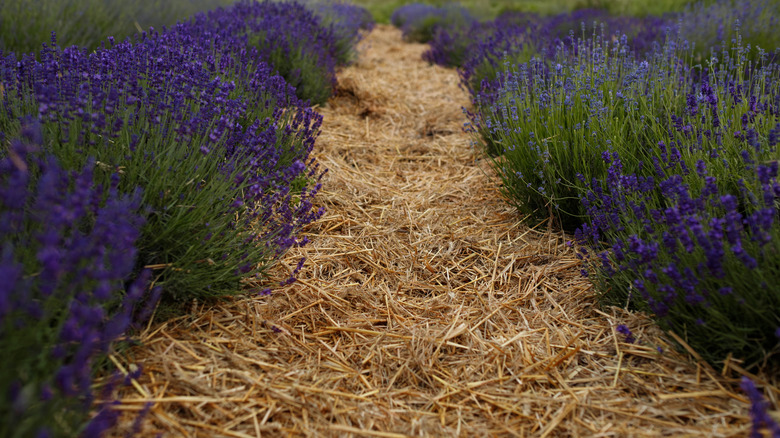
While there are plenty of other ways you should be using straw in your yard, apart from the obvious monetary savings, there are advantages to using it for your garden paths. When laid thick enough, it will cover the soil and limit weed growth. The straw will also be better to walk on than wet or muddy soil. Plus, it will stop soil from being washed away during periods of heavy rainfall. In fact, straw is used to cover empty lots during winter as a form of erosion control.
You'll probably find that one of the major benefits of using straw for your garden paths is that you don't have to do any elaborate ground preparation. You might like to cover the path area with cardboard first, as this will smother any weeds and prevent the straw from breaking down too quickly. But apart from that, it's just a matter of breaking up the bale and laying the straw down over the area. Wetting it down as you go can help to keep it in place. It will break down over time (and add organic matter to the soil beneath), so you'll need to top it up at least once a year. And if down the track you decide that you want to upgrade your garden path, there's no need to toss the used hay because you can create compost or let the straw decompose and use it for your garden beds.