

How To Turn Copper Pipes Into DIY Windchime Decor With Industrial Charm

We may receive a commission on purchases made from links.
Industrial design decor is grounded in contrast. For example, it pairs the likes of reclaimed wood beams on the ceiling with gritty features like exposed copper pipes. For DIYers Chica and Jo, these visual elements have become the creative inspiration for craft projects like this handmade wind chime. Built from copper pipes and craft wood rounds, these pieces add industrial flare to outdoor spaces and tie in the exterior with the rest of the home's design.
There are a couple of places you can find this DIY's materials. For a style that leans more toward industrial chic, look for supplies at home improvements stores. There, you'll find the likes of uxcell Copper Round Tube and possibly even Woodpeckers Wood Discs in abundance. If, on the other hand, your prefer a vintage industrial style, scout around local auctions or Facebook marketplace. If you want to make wind chimes out of repurposed household items, like aged copper pipe, those are the places to find them.
As far as the exact numbers are concerned, the chime calls for at least six pieces of ½-inch copper pipe at varying lengths, roughly 8 feet total, and three craft wood rounds of different sizes (large, medium, and small). Your chimes additionally require crafting cord. Finally, tools for this are basic. You'll need a drill with a bit that can push through metal, some scissors, and a pipe cutter like DKwoeshg Tubing Cutter, just in case your copper needs to be resized.
Turning copper pipes into industrial decor wind chimes
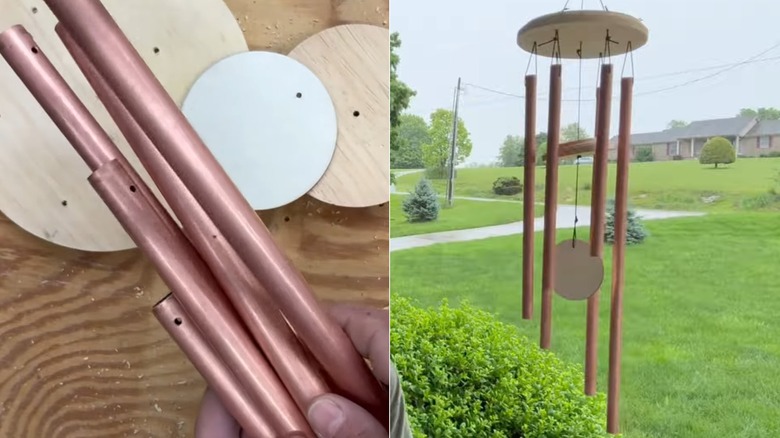
First, you'll need to cut the copper pipes into six pieces at various lengths. For example, lengths 10, 12, 14, 16, and 20 inches. If you bought pre-cut pipes, then you already have a head start. Next, drill two holes on one end of each of the pipes. This is where you'll eventually thread the cord to hang it.
Now for the wood pieces. The large one gets six holes drilled at equal distance apart around its perimeter (each 1 inch from the outer edge). It'll also get one hole in the middle and three positioned between the center hole in the craft round and the six on its border, while the medium wood round just requires one hole in its center. Finally, the small piece of wood for the clanger, just gets a hole drilled near the outer edge. However, you can take a shortcut by using something like a pojah DIY Wooden Christmas Ornament. Since it already has a hole at the top, you won't need to drill it.
Your last steps deal with assembling the wind chime. You'll need to attach the strings to the pipes and the pipes to the large wood round. Doubled up the pipes' cords for extra strength and arrange them in size order. Remember to leave enough cord slack so the pipes can swing. For the center, use a long cord and attach the medium-size wood round mid-way and the small wood clanger at the end. Finally, attach three strings of cord for the hanger portion.
Maximize the industrial design elements

Because wood and metal figure so heavily into the design sensibilities of this style, almost anything you do to enhance those elements will reinforce the chime's industrial decor vibe. For example, instead of leaving the wood rounds plain, add a few coats of a metal spray paint like Rust-Oleum Copper Hammered Paint to them. The texture from the hammered metal paint will give the wood a look similar to the copper pipes.
Or if you're into more vintage iterations of industrial design, like steampunk decor, you could attach pieces like vintage copper skeleton keys or antique clock gears to the bottoms of the pipes. To do this, you'd drill two more holes in the end of each pipe and attach these decorative embellishments with the cord.
Finally, you'd make a totally unique wind chime if you swapped out the cord and replaced it with copper-colored decorative chains. PH PandaHall Iron Cross Cable Chains are an affordable example of what you'd look for. These could be attached to the wood round with eye-hooks and to the pipes with copper S-hooks for a totally industrial look then leans into the edgy design created by the copper pipes.