

13 Laundry Room Features That Make The Job Easier
We may receive a commission on purchases made from links.
Whether it's just one or two loads a week that you need to worry about or you're cycling the machines daily to satisfy demand for clean clothes, there are certain laundry room features that can make life easier. Good lighting, for example, ensures that you can see what you're doing, while well considered storage means you won't end up clamoring for counter space when you need to fold your clothes. Likewise, shelves can elevate your daily detergents and softeners and, in doing so, raise your laundry game.
In the guide below, we've highlighted 13 laundry room features that will almost certainly make laundry day easier. Some come down to maintenance, like hard-wearing cabinet finishes and flooring that can withstand the rigors of such hard-used spaces. Others, while not essential, will invariably save you time, like ensuring you have hampers ready to organize your clothes. There are things to consider when planning your laundry room layout — perhaps during a home remodel. You'll find strategic tips to help your space work double duty in the winter as a mudroom. And if you're running out of storage, you'll find solutions to eliminate unwanted laundry room clutter from Costco and other similar big-box stores. Whether you're in the throes of updating your space, or feel like your laundry room is thwarting your routine, you're sure to find an idea to help below.
You're unlikely to regret a larger laundry room
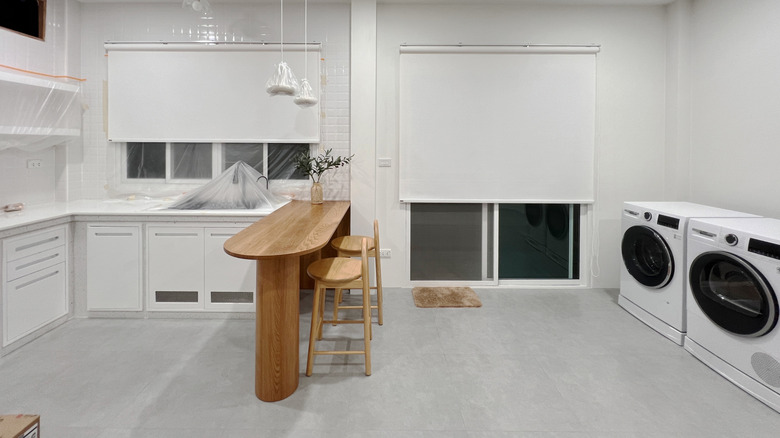
The first laundry room feature that's almost guaranteed to help make laundry day easier is, quite simply, more space. It could be that you're remodeling, or that you're thinking of re-designating another room in the house to laundry. Either way, Anthony Pillinger, director at Swell Homes, said to Houzz, "Don't make the mistake of designing a too-small laundry [room]." This, he said, is especially important in busier households, where clutter and dreaded piles of laundry can quickly dominate smaller spaces.
As for what "enough space" looks like, that depends on you, your household, laundry routine, and how much space you have available. However, as a general rule of thumb, 80 square feet is a decent starting point — more if you have a large family. Ultimately, it's much easier to manage your washing if you have the space versus desperately trying to maximize every square inch in a smaller laundry room.
Mounting cabinets on the wall can keep your floors clear of clutter
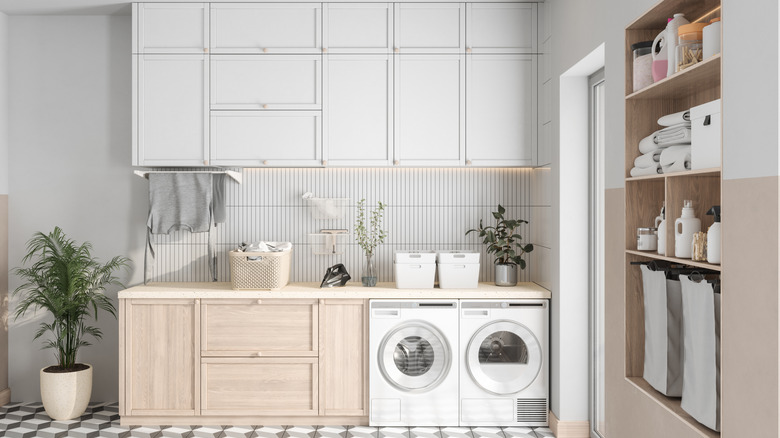
In order to create a functional laundry room, it's important to think about more than just the clothes you'll wash. You should also consider your detergents and softeners (plus spare bottles, if you like to be prepared). Stain removers need a place to live, and so, too, do things like pegs if you use an outdoor washing line. The other thing to bear in mind is that laundry rooms are commonly used as a holding ground for things that don't neatly slot into other parts of the house. Dog-walking gear, for example, and sports equipment. In smaller households, such clutter is common.
So, what are we getting at, exactly? Well, in order to keep your laundry room uncluttered, it can pay to think hard about your storage. And as in most places around the house, less is rarely better. Consider maximizing your vertical wall space with cabinets, which will provide a house for detergents, softeners, and other laundry items. The goal is to keep your counters clear of clutter, which in turn ensures there's space to put your clothes on them — instead of tossing them in a pile on the floor.
For things you need every day, some shelves can make a big difference
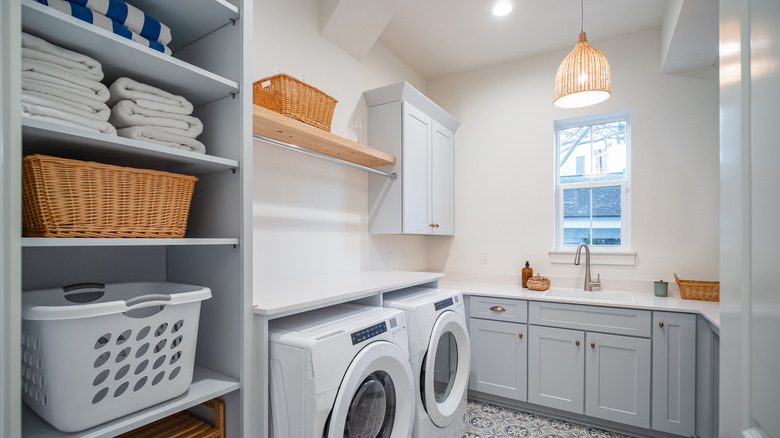
Like cabinets, a few shelves along your walls can work very hard to keep your counters clear of clutter, thereby freeing them for folding your actual laundry. You can keep things within reach that you use everyday, like laundry consumables. If your laundry room is by your front or back door, you can also keep items that you take when you leave, like dog leads. Depending on the size of the shelves, you can also keep some baskets on them, so that they're ready to pop your clothes into as soon as they're washed and folded.
In other words, shelves are one of the easiest ways to organize your laundry room, but you'll want to bear some things in mind before you install them. Firstly, if you intend to keep baskets full of clothes or lots of heavy detergent bottles on them, you should ensure they're up to the job. Drilling the brackets into the wall studs can help here, but the shelf's load-bearing capacity should also be rated to hold what you need to store on it. Pay attention to height, as well. Too high, and using them for piling clothes in baskets may not be practical. Too low, and things like bleach and detergent may be too easy to reach for pets and curious kids.
Consider deeper counters for laundry organization

We've touched on the importance of folding space already. While it's important to try and keep it clear (so that you can actually fold your clothes), it's also a good idea to allow yourself plenty of space in the first place. It's not essential, but installing deeper counters than you would in, say, your kitchen will certainly make your life easier in the long run. As Brett Patterson, senior designer and managing director at The Renovation Broker, said to Houzz, "Having a decent amount of counter space is a godsend in a laundry."
This makes sense. Again, it's not just your laundry that you need to worry about. On a day when you're cycling several loads, chances are you'll have a working pile of fresh laundry on the counter already when you come to fold the next. You may also need to pop a clothes hamper down on the counter. And that's before you spread those annoying odd socks out on the counter as you try to work out which goes with which. Add these things together, and they can quickly soak up space. But if you have the counter depth to counteract such problems, you should find you have the room to spread out as much as you need.
In lieu of counters, consider investing in a laundry station
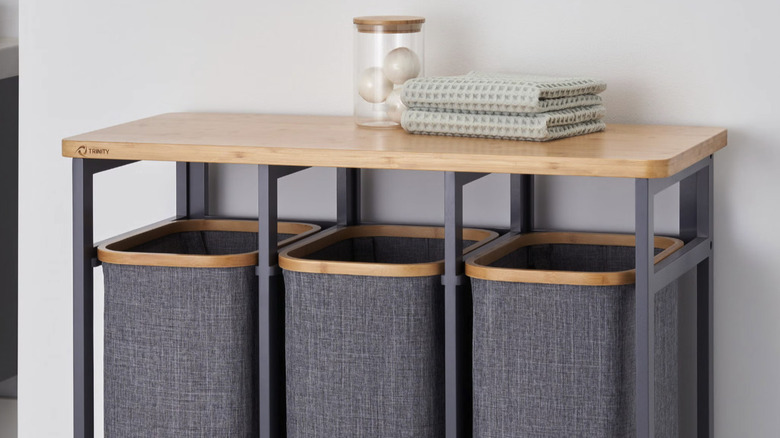
If you can't justify the cost of new counters, or your laundry layout isn't conducive to them, don't worry. It's a common mistake in laundry room design, in fact Pillinger explained that even "Professionals often forget to factor in space for a hamper in their laundry design." This means that dirty washing has nowhere to go, creating inevitable piles of clutter. Fortunately, there's an easy way around this, and that's to invest in a laundry station.
These products come in various styles — some with counters on top, like this Bamboo Laundry Station from Trinity, which provides a handy place to fold your clothes. Others come with hanging rods, which is useful for keeping things wrinkle-free when they're fresh out of the dryer. In most cases, these organizers also come with hampers, which you can use as bins for dirty laundry. Alternatively, you can use them as organizers for clean clothes. By making room for a laundry station, you can easily make up for a lack of storage or counter space elsewhere.
Depending on location, it could pay to double your laundry as a mud room
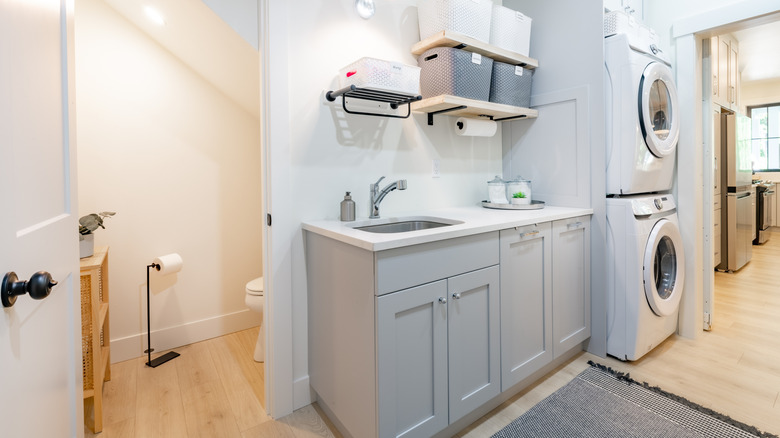
There are various mudroom ideas that will help you to transform your space, but one that you may not have thought of is to combine it with your laundry room. This is an excellent idea if your laundry room sits at the back of the house near the garden, or near your garage. It means that you and your family can kick off your dirty shoes and hang your rain coats in a space that's already dedicated to more utilitarian purposes. Don't forget, a laundry room is expected, at least half of the time, to store dirty laundry, so it makes sense to keep muddy boots and damp coats there, too.
You can also treat the space as your go-to for everything that you need when you leave the house and arrive back home. Add hooks near the door for your coats and dog leads, a stand for your umbrellas, and use those cabinets we mentioned earlier to keep other essentials, like pet treats and dog present bags. By combining two very functional spaces into one, you'll free up space elsewhere in your home, while keeping your household's "dirty work" from spilling into the rest of the property.
Don't forget a drying rack

Whether you prefer to air-dry your clothes and save on dryer costs, or have delicate items that you'd prefer to keep clear of the drum, it's useful to have a drying rack. However, having one means two things. Firstly, you need to actually have one, which brings us to the second consideration, and that's space. You'll need to ensure you have in order to set it up without making the rest of your laundry room unnavigable.
To get around this and make your laundry life even easier, you could consider hanging a fold-out drying rack on your ceiling or buying one that mounts to the wall, like this foldable laundry rack from Petalux. This will keep things more streamlined when it's not in use, and forgo the need to make it play nice with the other items in your cabinets. It's also useful if you don't actually have cabinets in which to keep your rack. If you do choose to install a rack on the wall, install it near a heater or heated vent, to help aid your dry times (as long as hanging clothes do not block the vent). Importantly, ensure that when it's extended, it doesn't get in the way of your laundry room door, or those of your washing machine and dryer.
A deep sink makes dealing with stains much easier
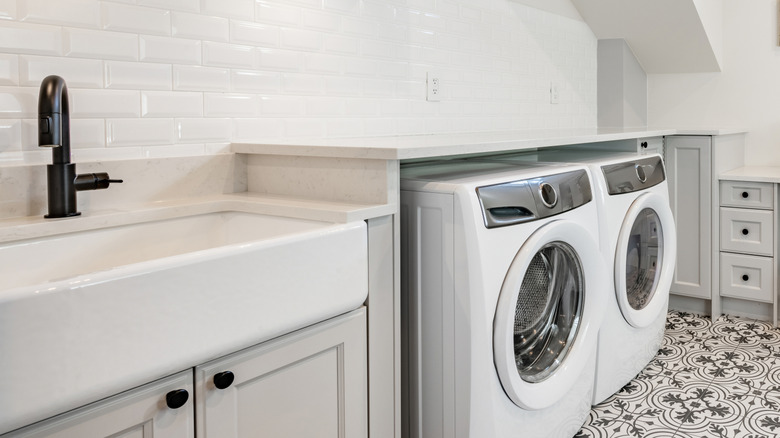
You might think that a decent washing machine and a large, energy-efficient dryer are all you need to handle your laundry. However, for clothes that are too delicate for machine washing, or for stains that need the rough treatment by hand before they go in the drum, it's also worth having a sink. But choosing the right sink for your laundry room is not quite the same as, say, your bathroom or kitchen. Given that you may need to soak several large garments at a time — without flooding your space whenever you do it — deep is generally better.
Not only will this make soaking your clothes easier, but it will also prove useful for other utility tasks. You can use it as a spot to soak and clean paintbrushes, for example, remembering that you'll probably be less concerned about stains in the laundry room sink compared to those in your gorgeous kitchen. Depending on the size of the sink (and, indeed, the size of your pets) you could also use the sink to bathe your dog or, dare we suggest it, your cat. Finally, the laundry room is a better place to scrub down dirty boots than in the kitchen or bathroom, especially if it's deep enough to deal with your Doc Martens.
A hanging rod alleviates worries about wrinkles

Installed in your laundry room, a hanging rod can be a very useful addition. It can certainly make life easier when you need to hang clothes fresh out of the dryer versus running them upstairs to the cupboard. You'll also be glad of a hanging rod if you decide to double up your laundry and mud room. Of course, if you're going to hang both daily coats and clean laundry, you may want to include two rods, rather than dirtying fresh laundry with a muddy raincoat.
Either way, thinking about where you'll install your rail is important to make the most of your space. Speaking to Houzz, Julianne Bull, principal designer at The Den Interiors, said, "A simple solution is to install the rail underneath the overhead cabinets." This would put the rail close to hand while ensuring it doesn't stick out or get in the way. Alternatively, she added, you could create a feature out of it by hanging it from the ceiling. It really depends on the space you have available, and how much rail-space you need for your clothes. If it's just a few shirts once a week that need to be hung, then a small rail under your cupboards is a small addition that could make a big difference to laundry day convenience.
It can't hurt to have a place to iron
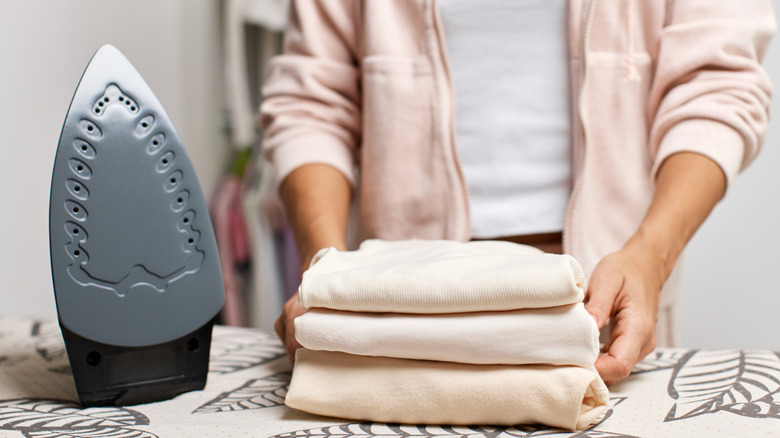
Like racks and rods, an ironing board is an essential laundry room accessory for many households. But they're not always the easiest items to store. One way to make your life easier and prevent the board from getting in the way is to install it on the wall. Such solutions are widely available, like this Wall-Mounted Ironing Board from Ivation. Mounted to the wall of your laundry room, it ensures the board is always on hand when you need it, but that it doesn't soak up undue floor space.
Alternatively, if you have space, you could install a tall cabinet in your room to accommodate taller items. This could include your ironing board, ensuring it's tucked away when not in use. It could also include a cordless vacuum, along with cleaning supplies like your mop and broom, thus decluttering your home even further. Either way, paired with a hanging rod, you can get your clothes ironed as soon as they're out of the dryer, then hang them immediately to save them from creases.
Aim for finishes that both hide and minimize scuffs
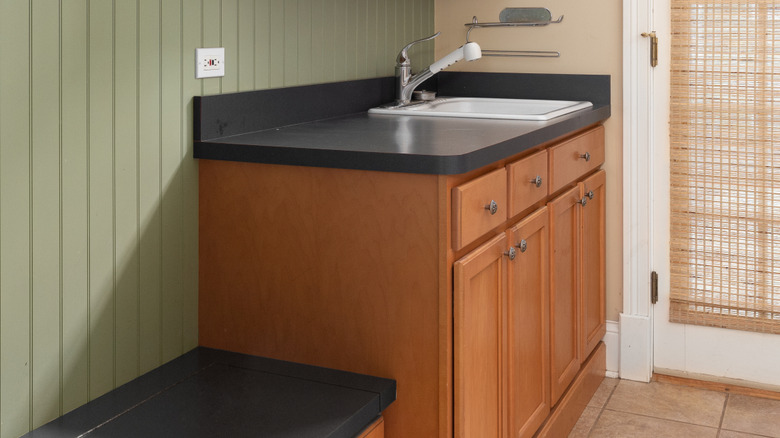
When you're specifying things like cabinets, countertops, and flooring in your laundry room, think about which finishes are easiest to clean and maintain. Laundry rooms are utilitarian spaces, which means that the surfaces and walls are much more prone to damage than in other rooms of the house. With that in mind, your fixtures and floor need to withstand a certain level of abuse. If they can't, they'll make your life much more difficult as you try to keep them clean and in good condition.
Cabinets might be better off specified from natural wood, which can always be sanded should damage occur, versus high-gloss, which can chip and show smudges and scuffs very easily. As for the flooring you should choose for your laundry room, again, low-maintenance is the name of the game. Stone tiles handle life in the laundry well, standing up well to accidental drops and spills. And just because these choices are practical, that doesn't mean you can't have a little fun with it. As interior designer Lonika Chande pointed out to House and Garden, laundry rooms are often much smaller than other spaces around the home. With that in mind, she said. "It's an opportunity to lean into color and pattern and to make it a happy space to be in."
If you have space, build in a linen closet
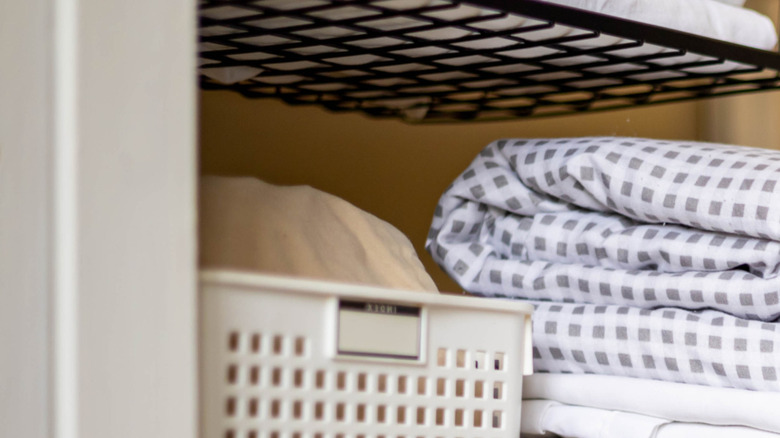
Again, this is hardly a necessity, especially if you already have a linen closet somewhere upstairs — perhaps in the bathroom, or a cupboard in your walk-in closet. But if you have space or a spare cabinet, or are remodeling your laundry room anyway, it could be worth at least considering. Having the linen closet right next to (or, at least, in the same room as) your laundry appliances means you can fold your towels and linens and store them immediately.
That convenience aside, you'll also save yourself time and annoying trips upstairs, since you'll have to carry fewer baskets of laundry. Not only that, but an airing cabinet in your laundry space could make another part of your laundry routine easier — putting your actual clothes away. If you're limited on storage upstairs or in the bedroom because it's currently trying to accommodate towels and linens, adding a cabinet in the laundry means you'll have more space to store your clothes. It may not solve your need for genius clothes storage solutions, but it'll at least give you some precious extra room to work with.
Don't ignore the importance of lighting
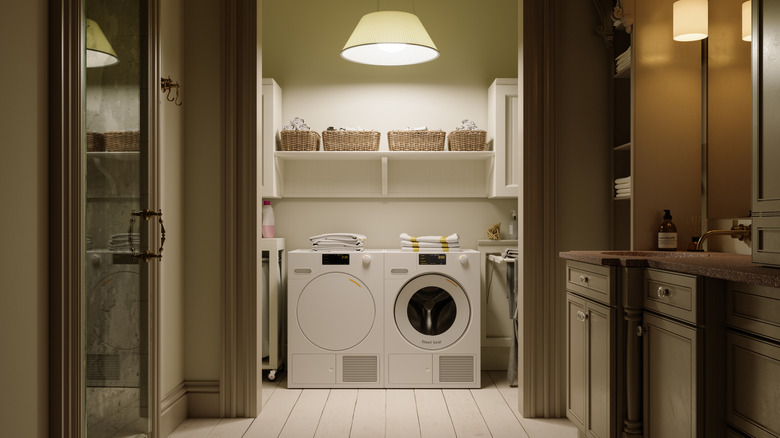
Our final feature is actually a tip to help avoid one of the most common laundry room lighting mistakes. As we mentioned earlier, these are utilitarian spaces which can easily become cluttered. Being able to see is a requirement for safety, especially if you usually enter the room behind a basket piled to the ceiling with dirty clothes. So, what exactly is the feature? Well, it's simple: ample illumination.
It can help to think about your space in much the same way as you'd design your kitchen or living room. That means layering your lighting. The first layer is your ambient lighting — the general purpose lighting that allows you to see as you move around the room. Second, but no less important, is your task lighting. These are the lights that help you see and work safely, whether that's measuring chemicals, rinsing stains in the sink, or sorting socks. There's really nothing more annoying than losing a single sock because you can't see where the darned thing went. Finally, consider your accent lighting. This is not, strictly, a requirement. But like we said earlier, nobody said you shouldn't enjoy being in your laundry room. If it has unique architectural features, or perhaps some family pictures on the wall, highlight them with accent lighting and give yourself something to smile about when you're folding after sundown.