

The Best Way To Keep Your Space Organized, According To Warm Minimalism
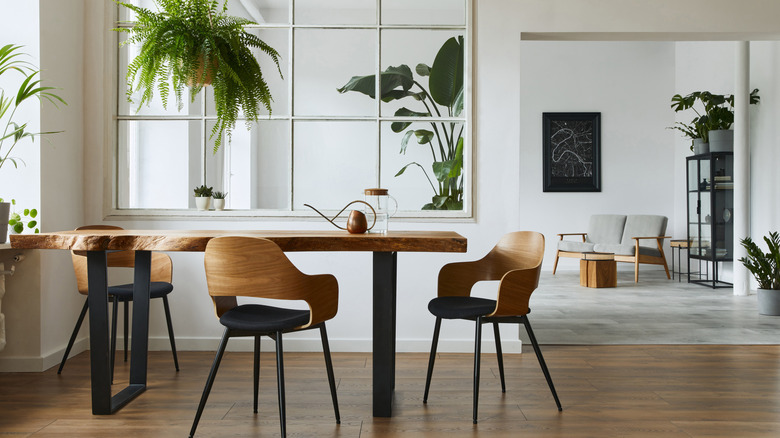
The interior design world has been slowly but surely moving away from the impersonal, crisp white-and-gray minimalist spaces that defined the 2010s. In its place, new design philosophies have emerged. While some have enthusiastically embraced the opposite end of the spectrum — maximalism — others are more interested in a middle ground. This has been branded "warm minimalism," and it proposes a balanced approach to organizing your home based on personal curation, multi-functional storage, and intuition.
Warm minimalism is interested in adding personality to your decorating scheme, without sacrificing the calming quietness that makes the minimalist aesthetic so popular. There is still an aversion to clutter, but it is softened by an openness to integrate personal artefacts into the decor. As interior designer Kathy Kuo tells Martha Stewart, "while minimalism typically omits these kinds of decorative accents, warm minimalism welcomes them." You can curate your belongings by decluttering first, then sorting them into pieces you want to display, those you want to keep but hide from view, and those you have no use for. Smart, integrated storage will house the former, while thrift stores will accept donations of the latter.
Warm minimalism's balanced approach to decor
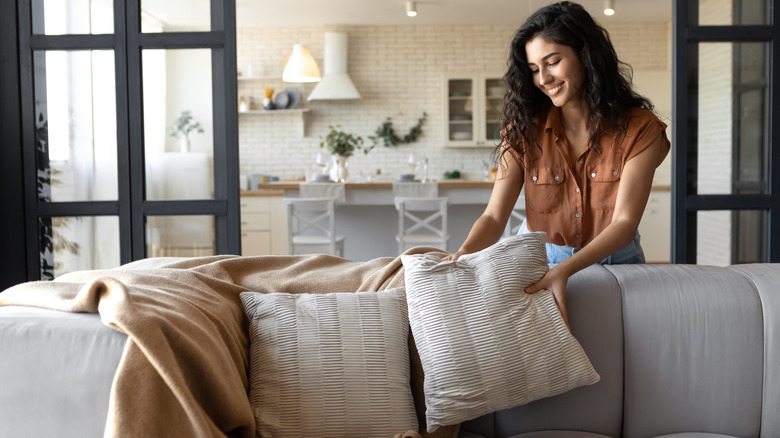
A dedicated minimalist would think long and hard before taking a cute vase they found at a lively street market home with them. A warm minimalist, on the other hand, can be much freer with their choices because they know how to integrate that vase into their decor without adding clutter. If you want to bring warm minimalism into your home design, whether you're coming from one end of the spectrum or the other, the first step is to take stock of what you already own. Remove your possessions from their current location and start fresh. Don't attempt to tackle an entire room in one go, though. Instead, start with a shelf or a drawer. Or go by category, like ceramics or clothes.
Then, it's time to sort your things into the three groups mentioned above: okay to display, ideal to conceal, and great to donate. In warm minimalism, you'll want to curate your decorative vignettes to bring interest and charm without being disruptive. To achieve this, stick to items that feel essential to you, whether because they truly represent your taste or because they tell your story.
If possible, organize them in balanced groups of three or five, and stick to a limited color palette to reduce visual noise (neutrals and earth tones are popular choices). Use different textures, shapes, and sizes instead of colors and patterns to create a sense of movement and contrast. If your collections are too large to display all at once and you're certain you want to keep every piece, consider rotating your decor by season or mood.
Warm minimalism's balanced approach to storage
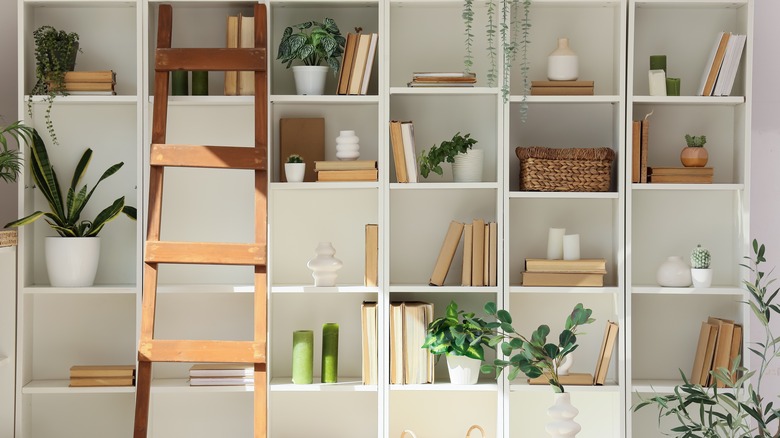
Once you've decided which items to show off and which to part ways with, you're left with those you simply need, but will seriously cramp your style if left out in the open. Warm minimalism solves this with integrated, smart, and gorgeous storage solutions that do their job efficiently, without compromising your space's overall aesthetic. A good starting point, and one of Kuo's suggestions, is multi-functional furniture. "Choose furniture pieces with built-in options, like a storage ottoman instead of a coffee table, or a sideboard instead of a console," (per Martha Stewart). This means you won't need additional pieces just for storage; find ways to optimize the ones you already have. Other great options include storage beds and storage benches.
For an even more seamless look, carve nooks into walls, kitchen islands, and kitchen cabinets, hiding them behind artwork or paneling. For example, you can install an appliance garage in your kitchen to reduce mess. Similarly, utilize your cabinetry and wardrobes to their full potential by using stackable boxes in tall cupboards, dividers in large drawers, and, if planning from scratch or renovating, taking these storage spaces from floor to ceiling. When bringing items into your space solely meant for storage, such as baskets and boxes, stick to a minimal color palette for cohesion and opt for natural materials for warmth.
As a final note, make storage convenient. Items that you use frequently should be easy to store and access, so that doing so doesn't feel like a waste of time. Identify the spots where clutter naturally accumulates, introduce a stylish container there, and storing them away will come naturally.