

The Fire Hazard That May Be Lurking In Your Garage
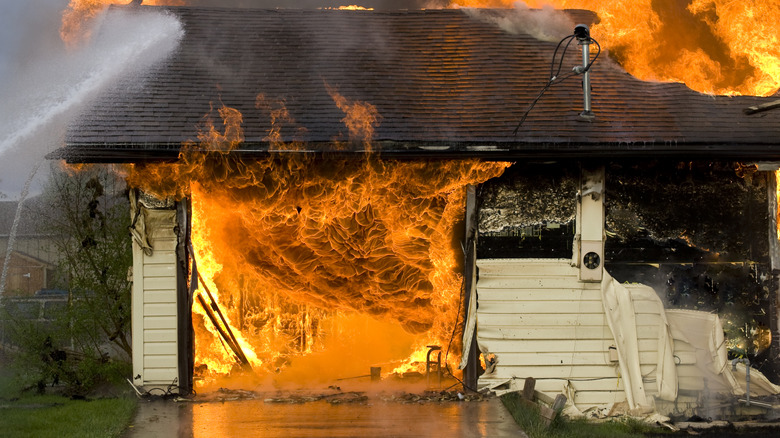
According to the U.S. Fire Administration, garage fires cause more injuries and financial losses than fires that start anywhere else in the home, since the garage is often a storage area for combustible and flammable products. Additionally, closed-off garages aren't a safe storage area for your propane tank because of the risk of a buildup of the flammable gas in case of a leak. Outdoor storage allows for ventilation.
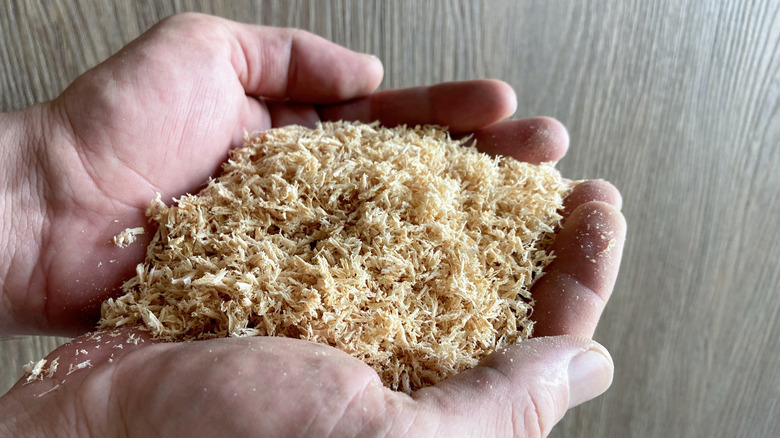
There's another material that you shouldn't store inside an enclosed garage because of the increased risk of fire — sawdust. The fine wood particles that make up sawdust are more combustible than most people think. The airborne particles could even cause a dust explosion. Dust explosions are typically more of a concern in industrial settings than when doing woodworking projects for beginners in your garage, but if the wood dust particles suspended in the air are concentrated enough, they could explode from the sudden introduction of a flame or static electricity spark.
Sawdust is far more flammable than the lumber it came from because the sawdust cumulatively has more surface area than the same weight of a piece of lumber, meaning it can interact with more oxygen in the air. Finer sawdust particles will burn faster than larger particles, but both of them burn far faster than a block of solid wood.
How to protect yourself from an accumulation of sawdust
If you want to reduce the risk of a sawdust fire in your garage, you should always take woodworking safety precautions when doing home projects. One key step is regularly stopping and cleaning up the mess while you're working. Carefully use brooms and shop vacuums to remove any large amounts of sawdust. You don't have to do a thorough cleaning until you're done with your project, but occasionally removing accumulated sawdust is an important step. Wear a mask rated for dust filtration to protect your lungs.
If you're using power tools that have sawdust ports, make use of them to reduce the level of particles that accumulate in the garage. Power sanders often have a container or bag on the back that collects some of the sawdust as you're working. Some tools have a port where you'll connect the hose of a shop vacuum to grab the particles as they appear.
After you finish your project, remove as much sawdust from the garage as possible. A shop vacuum is a good starting point, as long as it has a high-quality filter that will capture the finest particles instead of ejecting them back into the air. Although you can use a broom to sweep up and remove most of the sawdust, you will cause some of the finer particles to fly into the air, reducing air quality inside the garage. Don't forget hard-to-reach spaces like behind your equipment, and clean up any sawdust clinging to walls and vertical surfaces, too.