

How Much Concrete Do You Need To Fill Your Cinder Blocks?
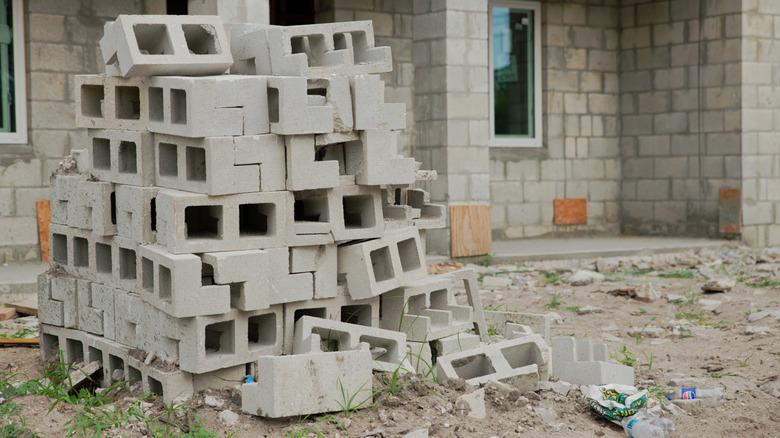
You can use cinder blocks for a variety of projects at home, including a makeshift bookshelf, raised garden bed, or fire pit. One gardener even used cinder blocks for a DIY garden bench. They're popular in part because their built-in cavities help keep their weight down, making them easier to handle for DIY projects. They're also useful for some professional construction jobs, such as small sheds or garden walls that aren't load-bearing.
If you want to make your cinder blocks stronger, more soundproof, or better insulated (while also allowing them to be used in load-bearing situations), you can fill the cavities with concrete. Although the hollow sections make them easier to manage initially, adding concrete to the hollow areas once they're in place provides the desired strength without forcing you to wrangle heavier blocks while building a wall or another structure.
Determining how much concrete you need to fill your cinder blocks depends on the size of each unit. If you're using standard-sized cinder blocks, their nominal dimensions are typically 8 by 8 by 16 inches, and they usually have two cavities. (However, multiple other sizes, shapes, and numbers of cavities are available.) To fill the two cavities in a standard cinder block, you'll need about 0.25 cubic feet of concrete. If your 60-pound bag of concrete mix yields about 0.45 cubic feet of hardened concrete, that would theoretically fill nearly two blocks.
Concrete needed to fill non-standard sizes of cinder blocks
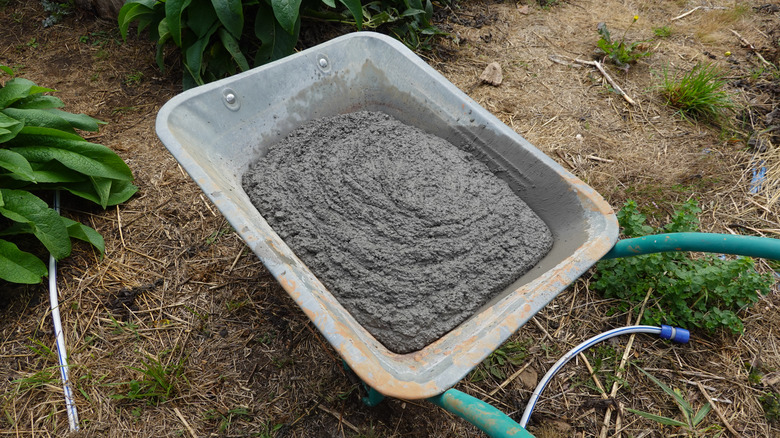
Although cinder blocks with cavities measuring 8 by 8 by 16 inches represent the most common size available, other sizes may work better for your project. If you plan to fill the cavities of non-standard sizes of cinder blocks, you'll need to recalculate the amount of concrete or grout required.
Some designs are narrower than the standard size, measuring 4 or 6 inches in depth while maintaining the 8 inches in height and 16 inches in length of the standard option. The block measuring 6 by 8 by 12 inches would need about 0.17 cubic feet of concrete to fill its cavities. One that measures 4 by 8 by 12 inches would need about 0.125 cubic feet of concrete for its cavities. Considering a 60-pound bag of concrete makes about 0.45 cubic feet, you could fill roughly 2.5 to 3.5 cinder blocks with one bag when using these sizes.
Wider concrete blocks are also available in nominal depths of 10 or 12 inches in depth paired with the standard height and length. The 10-inch deep block would need 0.33 cubic feet to fill the two cavities, while the 12-inch deep block needs about 0.39 cubic feet of concrete. You'd need to mix a little less than one bag of concrete to fill these cavities.
Should you fill all the cinder block cavities for strength?
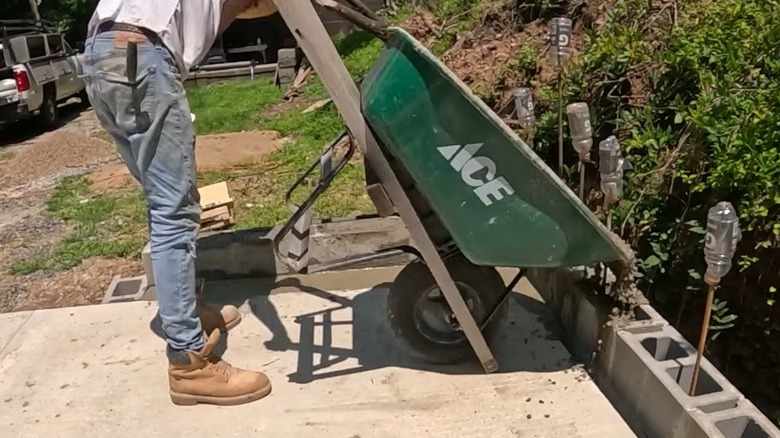
Considering you'll need about one bag of mixed concrete to fill the cavities on just two standard-sized cinder blocks, you may be facing a significant cost to fill all the cavities in a large project. (You might pay $4 to $7 per bag of concrete.) Although filling these cavities maximizes the weight that standard cinder blocks can hold, you might be able to avoid having to fully fill each one, based on the design of your project.
You need to fill cinder blocks with concrete when you want the added safety for managing load-bearing walls, taller walls, or structures that need to support a significant amount of weight. You can potentially skip adding concrete to the blocks used for interior walls that are not part of the structural support. Some masonry designs call for reinforcing and grouting only specified cells, which can reduce the amount of material required compared with fully grouting the wall. If you only need acoustic, thermal, or fire protection in a particular area, though, filling the cavities is usually optional. You might also want to just fill part of the cavity when you're seeking thermal or acoustic benefits, cutting down on your costs.
Ultimately, you'll need to check your local building codes to determine when cavities must be filled and reinforced, particularly for structural projects. Some local codes may also require any exterior wall made of hollow cinder blocks to be filled.