

The Drought-Tolerant Shrub With Fragrant White Flowers To Plant In Your Yard
There's something so dreamy and majestic about white blooms in a garden. When you're looking for the best perennials to grow for gorgeous white flowers, don't overlook shrubs. One of the prettiest for early spring drama is white forsythia (Abeliophyllum distichum). Much like its better-known distant "cousin," yellow forsythia (Forsythia spp.), white forsythia blooms when few other plants have woken from their winter slumber. Best of all, it's drought-tolerant, so it can withstand a little neglect.
The flowers of white forsythia grow on multiple stems encircling the rounded shrub. The clusters of white blooms are often kissed with a tinge of pink. Even better, the white blossoms of this low-maintenance shrub perfume the garden with the sweetly delicate scent of almonds. For gardeners who prize fragrant, romantic shrubs, white forsythia is an especially aromatic way to kick off the season.
White forsythia is perennial in USDA Hardiness Zones 5 to 8. Reaching about 3 to 5 feet tall and 3 to 4 feet wide, its size is compact enough to tuck amongst other plants, but substantial enough to serve as a backdrop to perennial flowers and herbs, once its own petals have dropped. Its early bloom time also makes it a valuable asset to bumblebees and other bees, which have few plants to turn to in late winter and early spring.
Unfussy white forsythia only needs sun and post-bloom pruning
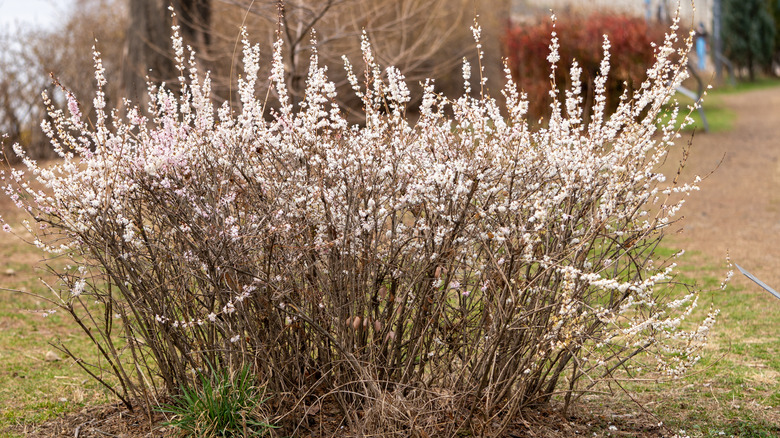
Set white forsythia where it will get full sun or partial shade during the day. While the shrub can prosper in partial shade, the more light it gets, the more it will bloom. Placement is a consideration for more than lighting conditions, however. White forsythia is not considered a "specimen plant" – in other words, an ornamental that can hold interest all by itself. That's because white forsythia really only comes into its own for a few weeks in early spring. When blooming, the shrub's white clusters have a way of making other colors pop. After that, the green branches are best considered a backdrop for other plants. Consider including them in a mixed border of shrubs that bloom during different parts of the warmer months.
White forsythia doesn't need much in the way of amended soil, although adding organic matter can help give it the drainage it requires. The shrub is well-known for handling occasional droughts, but dislikes the boggy conditions that come from poorly-draining garden beds. Otherwise, it can handle various "problem" soils, including alkaline ones.
Pruning can help rein in white forsythia's tendency to get a bit scraggly, but timing matters. White forsythia should be pruned immediately after blooming. Because flower buds appear on last year's branches, cutting the shrub back too early will "slash" your chances of seeing any flowers during the growing season. Instead, save your pruning until the flowering season is over. Do a light prune most years, and a more severe one every three years or so to keep the overall shape in check.