

Driveways Just Aren't Made The Same Way Anymore: How They Have Evolved

A driveway is a driveway, right? Well, they're not really. More specifically, they aren't the same as they used to be, because they've evolved to keep up with modern technology and our contemporary needs. What our ancestors used as a driveway was very different from what we use today. So if you've ever been curious about driveways and how they've evolved, you're in luck.
During medieval times, wealthy lords sometimes added a bit of curb appeal to their dirt roads, adding trees and hedges to the sides to make them look more luxurious and impressive. And then, in the 1800s, driveways were simple paths in the United States. Not only were they made of dirt, but they were also minimalist in shape: straight from point A to point B, without any unique, wavy design. Wealthy families did have driveways (called carriageways) that were designed for carriages or wagons. These often had a bit of gravel to help wheels move along rather than getting stuck in mud.
As carriages became more commonplace, and before cars grew popular in the 1920s, gravel wasthe go-to material. People who lived in fancy homes started to zhuzh them up by turning straight, practical driveways into curvy, elegant ones. They also began adding what we now call curbs: defined edges on the sides made with things like cobblestone.
The arrival of cars and modern driveways
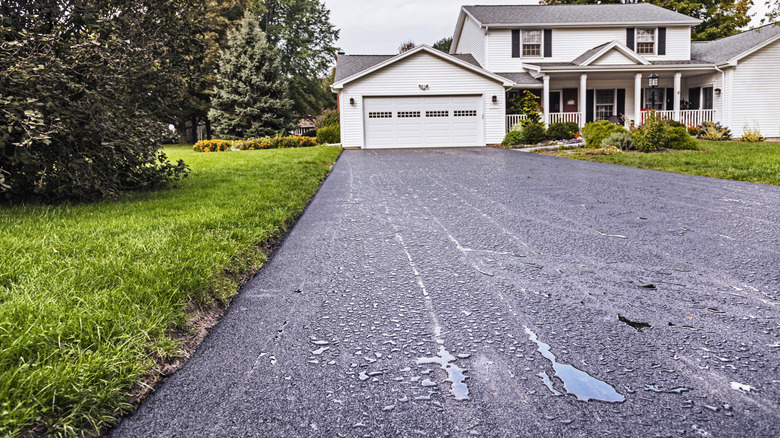
With the Industrial Revolution, more and more homeowners got a car. And with those heavy vehicles, driveways changed. Their shape began to accommodate larger, wider cars, and they also started to include a parking spot. As this happened and people moved into suburban homes, driveways became a status symbol for the middle class, not just wealthy landowners. That's when families started to look for creative ways to increase their home's curb appeal.
In the 1920s, concrete was the top driveway material because it lasted and was not damaged by heavy vehicles. Then asphalt was introduced and became a standard driveway material. Part of the reason was aesthetic: it's darker than concrete, which looks nicer and cleaner, even as it gets dirty. Concrete is made of sand, pebbles, rocks, water, and cement. Asphalt, on the other hand, uses bitumen, which is a hydrocarbon substance derived from petroleum.
Today, both concrete and asphalt are commonplace for driveways. The main difference is cost, but they also suit different homes and climates better. Overall, asphalt is a bit cheaper (around $5,200), where concrete is more expensive ($6,400 for the same driveway). Of course, factors can affect the real cost, including the size of your driveway and how much labor you need. In hot climates, concrete driveways last a bit better than asphalt, but the opposite is true if you live in colder regions of the country where concrete can crack from extreme weather. If you live in southern states or generally warmer parts of the country, then asphalt might struggle to keep up and turn into a sticky mess.
The future of driveways
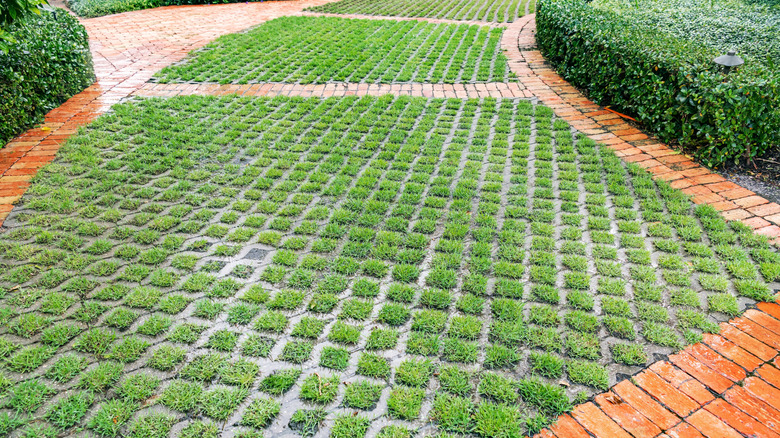
Today, we're seeing tons of innovations in driveway design and engineering. Many people are now interested in having long-lasting, sustainable, and affordable driveways. One main evolution is the inclusion of eco-friendly materials, like recycled crushed concrete and recycled asphalt. The usage of permeable pavers has also increased, which drain water better and allow the ground to absorb the moisture. These also prevent puddles from collecting on top.
Another material that exists today to make a driveway more permeable and eco-friendly is grass pavers. This isn't the same as just having grass as your driveway. Instead, it uses a base made of concrete or plastic. Grass paver driveways add the curb appeal of a beautiful lawn, and you won't get stuck in the mud on your way to work due to the durable base.
On the other hand, older materials like cobblestone are also widely popular. Cobblestones are a low-maintenance material that can give your driveway an upscale historic look, which many homeowners gravitate towards when designing their home. The benefit of constructing a new build in this day and age is that you can pull from a long history of materials, techniques, and inspiring driveway entrance ideas that match your style, values, and budget.