

Everything You Need To Build An Impressive DIY Wooden Hive For Bees
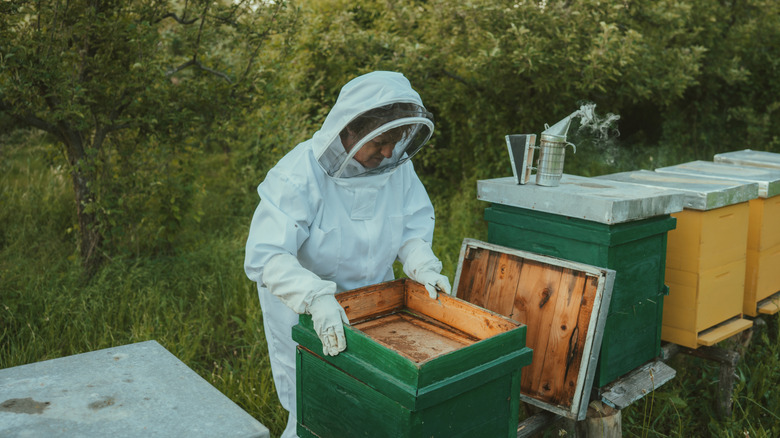
We may receive a commission on purchases made from links.
A world without pollinators is a world where your favorite foods all might just disappear. With pollinators suffering from a global decline, perhaps it's time you bring pollinators to your yard by making it a safe environment. If you want to take things a step further, consider beekeeping. You'll need a hive to get started, and you can find a starter hive on Amazon or build your own and save some money. All it takes is some wooden boxes, frames, a mesh screen, weatherproof cover, and an understanding of the craft — luckily the models already exist for you to follow.
There are multiple types of beehives to keep your garden. In the U.S., the majority follow the Langstroth model. It's named for Lorenzo Langstroth, a minister and apiarist, who discovered the concept of bee-space. Bees like to space their combs ⁵⁄₁₆ inch apart — given extra space, they will fill it in with propolis. Langstroth also recognized that bees build hives to be about 40 liters (10½ gallons) in volume. The Langstroth beehive is built with these dimensions in mind.
The hive isn't terribly complex. It's made up of three boxes, or supers, stacked deepest on the bottom, shallowest on top. Each box is made of 10 frames that offer foundation for the bees to build their comb. Every hive needs a lid to protect against weather and an inner lid to prevent the bees from gluing the lid onto the box.
Building a Langstroth beehive
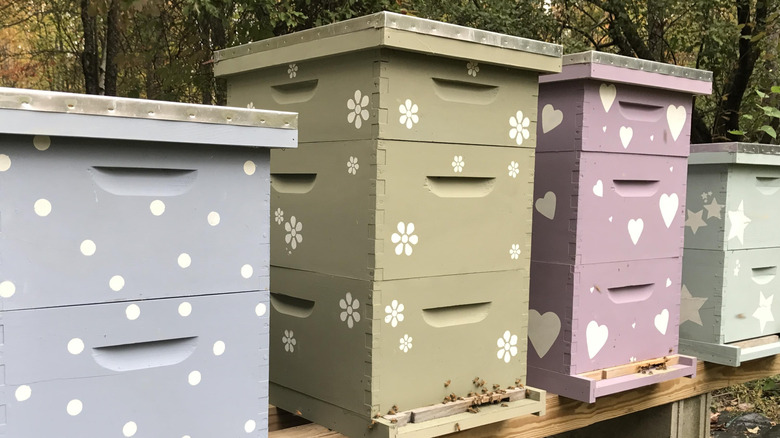
In crafting your own Langstroth hive, you'll need a few different materials. First, you'll need wood for the supers. You can buy wood secondhand to save money, or use wood glue and clamps to get use out of scrap pieces. You'll also need a weatherproof lid for the hive, a queen excluder (this will be a separate panel with specific dimensions), a dovetail jig, and an industrial stapler. When it comes to the frames that make up each box, you can make them yourself, but it may be easier — and still inexpensive — to simply order something like these unassembled frames from Amazon.
When cutting your wood — or gluing scraps together — the standard dimensions of your supers should be 20 inches by 16½ inches, with varying depths. Common depths are 9½ inches for the deep super, 6⅝ inches for the medium super, and 5¹³⁄₁₆ inches for the shallow box. Using the jig, you can cut the pieces to fit into each other, then staple to hold in place. The inner cover should be a ¼ inch thick piece of plywood with a thicker rim on each side of ⁵⁄₁₆ inch and ½ inch thickness. Finally, you'll add your queen excluder, to prevent her from laying eggs in the food, and stack your supers on top of a bottom board that acts as a base. Consider adding a mesh screen at the bottom, or a stand, to mitigate pest concerns.